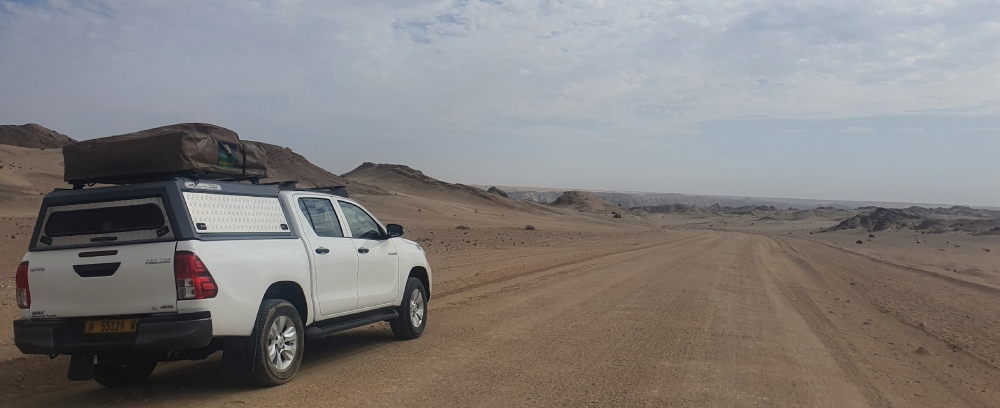
Car hire rates are calculated per calendar day and we always try to add all possible extras automatically so that you don’t have any hidden extra costs. We always recommend to include the maximum insurance cover, GPS, airport transfers and tyre and windscreen cover from the onset. If you haven't booked yet but you're looking for suitable car rental options, take a look at our fleet to get started. This also shows the basic list of what is included in the rental rates.
Namibia accepts most driving licenses throughout the world. However, we recommend the driver/s obtain an International License where possible.
- License must have a picture of the holder;
- It must state “Driver/s License” or “Driving License” in English;
- There must be an expiry date and this must be valid for the duration of your travels
We can pick up the rental vehicle at a location other than the town it was picked up at, after your journey. It is however important that you inform us of your arrangements when doing the booking.
We allow our clients to cross borders with our vehicles. It is however important to arrange it beforehand with our offices. Different costs and limitations may apply depending on which borders you want to cross.
In Namibia we drive on the left, the same applies in South Africa, Botswana, Zimbabwe and Zambia.
It is not advised. This is for your own safety due to animals found on the roads during this time and being dark there is little visibility. It is also for this reason that car hire insurance does not cover driving in the dark.
We would advise you to rent a satellite phone when travelling to remote destinations. Especially when traveling to areas where there is no mobile phone reception. It will also be advisable to rent a satellite phone when travelling to some neighbouring countries. Even though you might not use the satellite phone, it will give you peace of mind when traveling to areas with no mobile phone reception.
Our vehicles are equipped to drive off-road. They have switchable 4-wheel drive high and low range modes. Furthermore, they have traction control and a differential lock option. Most of the time, however, there will be no need to engage 4-wheel drive low range or the differential lock. To add to your comfort, and safety and peace of mind, we have equipped our vehicles with a secondary fuel tank, our emergency phone number allows clients to contact us should there be an emergency.
We can book an automatic vehicle for you, should there be availability.
Firstly, it is important that people are safe. If you were in an accident, you should first determine if all the occupants are cared for. Our vehicles are equipped with a first aid kit. We furthermore also supply an emergency phone should you need to call us. We also have a booklet in the cubbyhole of the vehicle which contains numbers of emergency services you might want to call. We however also have different collision damage waiver options from which you can choose to limit your liability should the vehicle be damaged. We do however recommend that you select a comprehensive cover to reduce your liability. Depending on the collision damage waiver cover you have selected, you will be covered for damages to the vehicle, windscreen, tyres and even sandblasting.
A flat tyre will need to be changed and we will ensure you know where to find the spare and the tools you’ll need. If it’s a mechanical issue and your car has broken down, you will contact us for assistance and we will do the rest. Since Namibia is a vast country and at times you can go a few hours without even seeing another vehicle on the road we will contact someone in the nearest town or lodge to assist if need be and arrangements will be made to get you the help you need or a replacement vehicle sent to you. Arrangements are made on a case-by-case basis, but we’ll always do what we can to assist and get you back on the road again soonest
Personal feedback which we got from clients, do confirm that Namibia is an extremely safe country to enjoy your holidays. It furthermore has friendly people who will more often than not assist you when in need. We would however advise you not to keep your expensive equipment unattended. This also applied when walking around any cities/towns. Yet this caveat may apply for wherever you might travel around the globe.
As far as malarial is concerned, the risk is only prevalent in the far Northern parts of Namibia. From May up to October the risk is however less. It is however advisable to take mosquito repellent with you and not to leave tent windows open where mosquitos can enter.
Namibia drives on the left side of the road. Like most countries, you need to have a valid driver’s license, when driving. An international driver’s license is required when the driver’s license is not in English. Wearing safety belts are compulsory. Road signs will indicate the relevant maximum speed limits. In general, maximum speed limits are 120 km/h on tar roads, 80 km/h on gravel roads and 60 km/h in towns. For your safety we would also recommend that you do not drive after sunset or cross running rivers. Overtaking of vehicles should only be done when you have an unobstructed vision of the road ahead.
With the right GPS and a map of Namibia, it is as easy as Apple pie. With these tools you’ll easily find your way in Namibia.